

Bodyweight Alternating Lunge
Quick answer
The Bodyweight Alternating Lunge mainly works the quadriceps and glutes, with help from the hamstrings. Alternating stationary lunges that strengthen the quads and glutes and train balance. Beginners: 2–3 sets of 8–12 clean reps, stopping before your form breaks down.
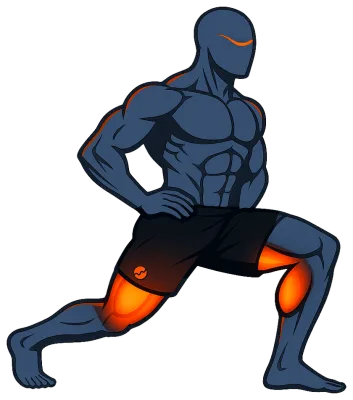
How to do it
- Stand with feet at hip width, hands on your hips.
- Take a big step forward with one leg.
- Descend until your back knee brushes the floor, torso upright.
- Push through your front foot to return to the start position, then switch legs.
Muscles worked
MainSecondary
- Quadriceps
- Glutes
- Hamstrings
Common mistakes
- Your front knee should not cave inward.
- Keep your torso vertical without leaning forward.
Sets & reps
| Goal | Sets | Reps | Rest |
|---|---|---|---|
| Strength | 3–5 | 3–6 | 2–5 min |
| Muscle | 3–4 | 6–12 | 90–120 s |
| Endurance | 2–3 | 15–20 | 60 s |
Leave 1 to 3 reps in reserve on most sets, and add load once you reach the top of the rep range with good form.
Variations & alternatives
FAQ
What muscles does the Bodyweight Alternating Lunge work?
Mainly the quadriceps and glutes. It also works the hamstrings.
How many sets and reps should I do?
Beginners can start with 2–3 sets of 10–12 reps. To build muscle, do 3–4 sets of 6–12 reps; for strength, 3–5 sets of 3–6 reps with longer rest. Stop 1–3 reps before failure and keep your form clean.
Is the Bodyweight Alternating Lunge good for beginners?
It is an intermediate exercise: learn the technique with a light load first, ideally with someone experienced, and progress in small steps.
Related tools
Log it, beat it
Kaizo's gym mode logs your sets, shows the muscles you worked this week and suggests the next weight.